For children and adolescents, early intervention is key. Research has consistently shown that addressing and identifying difficulties early on, along with providing appropriate accommodation and treatment shows the most positive long-term outcomes.
Assessments are one of the most effective ways to facilitate early intervention.
Our assessments are designed to help individuals and families gain clarity, understanding, and direction. We take a collaborative, strengths-based approach to evaluation, focusing not only on challenges but also on abilities, supports, and opportunities for growth.
We offer several types of assessments, each serving a different purpose depending on your concerns, goals, and needs. Some assessments help guide treatment planning and next steps, while others provide a more in-depth understanding of learning, emotional, or neurodevelopmental functioning. Choosing the right assessment ensures that recommendations are meaningful, individualized, and aligned with real-world needs at home, school, and in the community.
If you are unsure which assessment is the best starting point, we are happy to offer a consultation to help guide that decision.
A Comprehensive Clinical Assessment (CCA) is a strengths-based assessment focused on understanding an individual’s social-emotional functioning within the context of their family, school, and community. It explores areas such as emotional well-being, behavior, developmental history, family dynamics, stressors, and supports to clarify concerns and guide treatment planning. When appropriate, the assessment may also provide diagnostic clarification. CCAs can be conducted by any of our licensed clinicians.
The assessment typically includes interviews with the individual and caregivers, review of relevant background information, and clinical measures as appropriate. The process is collaborative and supportive, with the goal of better understanding strengths and needs and identifying appropriate therapeutic or community-based services.
Comprehensive
Clinical
Assessments
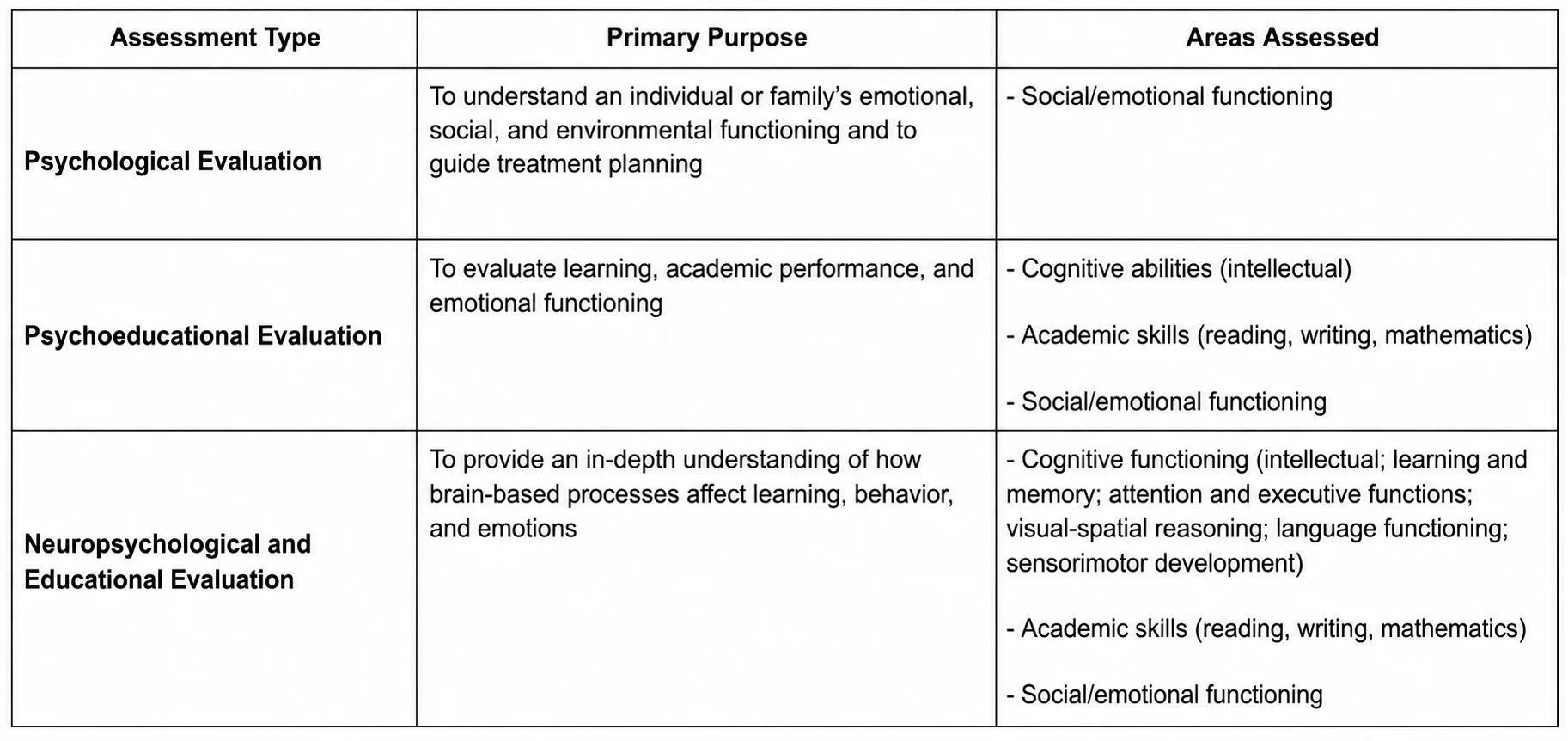
Psychological Evaluations
Psychological evaluations focus on understanding an individual’s emotional and behavioral functioning. These evaluations may assess areas such as mood, anxiety, attention, behavior, and social-emotional functioning to better understand presenting concerns and clarify an individual’s psychological and emotional needs.
Psychoeducational Evaluations
Psychoeducational evaluations focus on understanding an individual’s learning and academic functioning. These evaluations assess cognitive abilities and academic skills in areas such as reading, writing, and mathematics, along with social-emotional functioning. They can help identify learning differences and better understand factors that may be impacting academic performance.
Neuropsychological and Educational Evaluations
Neuropsychological evaluations provide an in-depth understanding of how cognitive and brain-based processes affect learning, behavior, and emotional functioning. These evaluations assess areas such as intellectual functioning, learning and memory, attention and executive functioning, language, visual-spatial reasoning, and sensorimotor functioning, along with academic skills and social-emotional functioning.
Evaluations
At Dynamic Minds, we offer individualized evaluations to better understand an individual’s unique strengths and areas of need. Evaluations are conducted by licensed psychologists and may help clarify diagnoses and guide individualized recommendations and supports. We offer psychological, psychoeducational, and neuropsychological evaluations based on the specific referral concerns.
These evaluations are a comprehensive process that typically includes the following components:
Intake:The process begins with an in-depth interview with the client and/or parents or caregivers to gather a thorough developmental, medical, academic, and emotional history.
Collateral Information: With permission, the evaluator may consult with other providers and school personnel, such as teachers and counselors, to better understand the child’s functioning across settings.
Observation:When appropriate, observations may be conducted in natural environments, such as a classroom or other educational setting, to better understand behavior, attention, and social interactions.
Record Review: Relevant medical records, educational documents, and prior evaluation reports are carefully reviewed.
Test Selection and Administration: A tailored battery of assessments is selected and administered to evaluate cognitive, academic, and emotional functioning.
Scoring and Interpretation:Test results are scored and interpreted to develop a comprehensive understanding of the client’s strengths and areas of need.
Feedback:Findings and recommendations are shared with the client and/or parents or caregivers and, when appropriate, educators and other professionals involved in their care.
Report Writing: A detailed written report is completed, summarizing results, diagnoses (when applicable), and individualized recommendations.
During testing sessions, a variety of tasks are completed, some of which are engaging and others more challenging. Breaks are provided as needed to support focus and engagement.